The moment came after a difficult treaty
Al-Miswar ibn Makhramah and Marwan ibn al-Hakam relate the long Hudaybiyyah account in Ṣaḥīḥ al-Bukhārī 2731–2732. The Muslims had set out intending ʿumrah. Negotiations ended with terms that felt difficult to many, including returning that year without circumambulating the Kaʿbah. When the treaty was written, the Prophet ﷺ told his companions to sacrifice their animals and shave their heads. He repeated the instruction three times, yet no one rose at that moment.
The report establishes this sequence but does not place a complete psychological explanation in the companions’ mouths. A reader may recognise shock and disappointed expectation in the setting, but that remains contextual inference, not another sentence of hadith. Fair reading also notices what follows: once the path became visible in action, the companions moved with urgency.
Private counsel became a visible next step
The Prophet ﷺ went to Umm Salama and told her what had happened. Her counsel was precise: if he wanted the instruction carried out, he should go out, speak to no one until he had sacrificed his animal, and call his barber to shave his head. She did not propose another speech or dilute the command. She proposed an action that would remove ambiguity and make the transition from ihram to departure unmistakable.
He went out and did as she advised. When the companions saw it, they rose, sacrificed, and began shaving one another’s heads. The narration assigns each role carefully: the counsel belongs to Umm Salama, the decision and action to the Prophet ﷺ, and the response to the companions. That precision is more faithful than reducing the account to one hero or a modern slogan.
What is established—and what is application
The authenticated report shows the Prophet ﷺ listening to his wife in a sensitive public moment, receiving concrete counsel, and allowing action to precede further words. It does not establish that quiet demonstration is always the best leadership style, or that every delay should be treated in the same way. Other situations may require explanation, correction, time, or a different consultation.
Within that boundary, the event offers a strong educational reflection. Useful counsel can come from inside the household. A private conversation can diagnose a public impasse without performance. A clear embodied next step can sometimes release a group from uncertainty when more words are not helping. These are editorial applications grounded in the account, not new prophetic quotations.
Hudaybiyyah through Sūrat al-Fatḥ
Sūrat al-Fatḥ calls what followed a clear triumph. Verses 24–26 mention the restraint of hands, the sanctuary, and the heated pride surrounding the treaty; the closing portion of Bukhārī’s narration connects the episode with those verses. Reading the sources together keeps Hudaybiyyah from becoming only a story of immediate disappointment, while also respecting how difficult the moment was for those living through it.
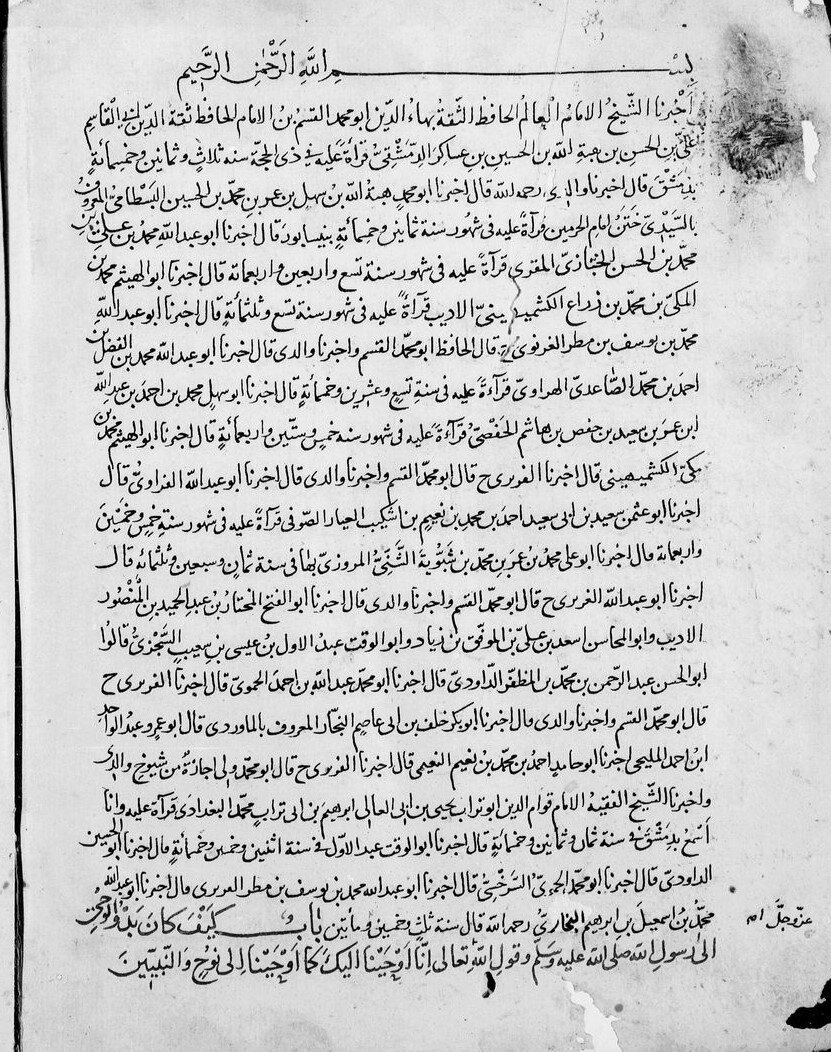
The accompanying image is a later manuscript page of Ṣaḥīḥ al-Bukhārī with an ijāzah of transmission. It is not an artefact from Hudaybiyyah and not a reconstruction. We chose it because it honestly points to the textual path by which this moment is known, while fully avoiding a depiction of the Prophet ﷺ. The image documents the source’s history; it does not decorate the unknown.
Qur’anic text, hadith, photograph and image rights checked on 19 October 2026
Texts and references
- Ṣaḥīḥ al-Bukhārī 2731–2732 — the Treaty of al-Ḥudaybiyyah and Umm Salama’s counselSunnah.com ↗
- Sūrat al-Fatḥ 48:1 — ‘Indeed, We have granted you a clear triumph’Qur’an.com ↗
- Sūrat al-Fatḥ 48:24–26 — the restraint of hands and the setting of the treatyQur’an.com ↗
- Manuscript of Ṣaḥīḥ al-Bukhārī containing an ijāzah, c. 1400Princeton Islamic Manuscripts / Wikimedia Commons, CC0 ↗