A child in his father’s arms
Anas ibn Malik reports in Ṣaḥīḥ al-Bukhārī 1303 that the Prophet ﷺ entered the home of Abu Sayf, whose wife nursed Ibrahim. He took his son, kissed him and smelled him. On a later visit, Ibrahim was in his final breaths and the Prophet’s ﷺ eyes began to shed tears. When ʿAbd al-Raḥmān ibn ʿAwf expressed surprise, he answered that this was mercy, then named both the grieving heart and the sorrow of separation while committing to words that please Allah.
Ṣaḥīḥ Muslim 2315 corroborates the heart of the scene through Anas: the embrace, the child’s last moments, the tears, and grief spoken without abandoning faithful speech. The authenticated picture is therefore not of a human being untouched by loss, but of a father and Prophet who feels loss without turning it into objection. That describes the report; it does not dictate how every bereaved parent must feel.
Mercy is not the opposite of patience
The Prophet ﷺ called his tears mercy. The wording itself distinguishes what happens in the eyes and heart from what the tongue chooses to say. It does not support the idea that faith erases sorrow or that tears prove spiritual weakness. Nor does it make grief a performance that must be hidden to look patient.
The report should not become a neat phrase imposed on someone in the first shock of loss. An editorial application is that consolation can begin with presence and listening, and that even a true text should be offered gently and at the right moment. Detailed questions about objection, lamentation, or a particular person’s conduct require qualified guidance beyond this article.
The eclipse did not become a family legend
The sun eclipsed on the day Ibrahim died. In Ṣaḥīḥ al-Bukhārī 1043, al-Mughīrah ibn Shuʿbah reports that people said it had eclipsed because of the death. The Prophet ﷺ corrected the claim immediately: the sun and moon do not eclipse for anyone’s death or life, and people should pray and call upon Allah when they see an eclipse.
The moment carries unusual intellectual honesty. A popular association could have magnified a deeply personal event, yet it was not allowed to circulate. What the hadith establishes is the denial of the supposed cause and the act of worship at an eclipse. The further thought—that truth needs no myth to preserve a person’s dignity—is editorial reflection, not a separate prophetic quotation.
What the Al-Baqi photograph can—and cannot—show
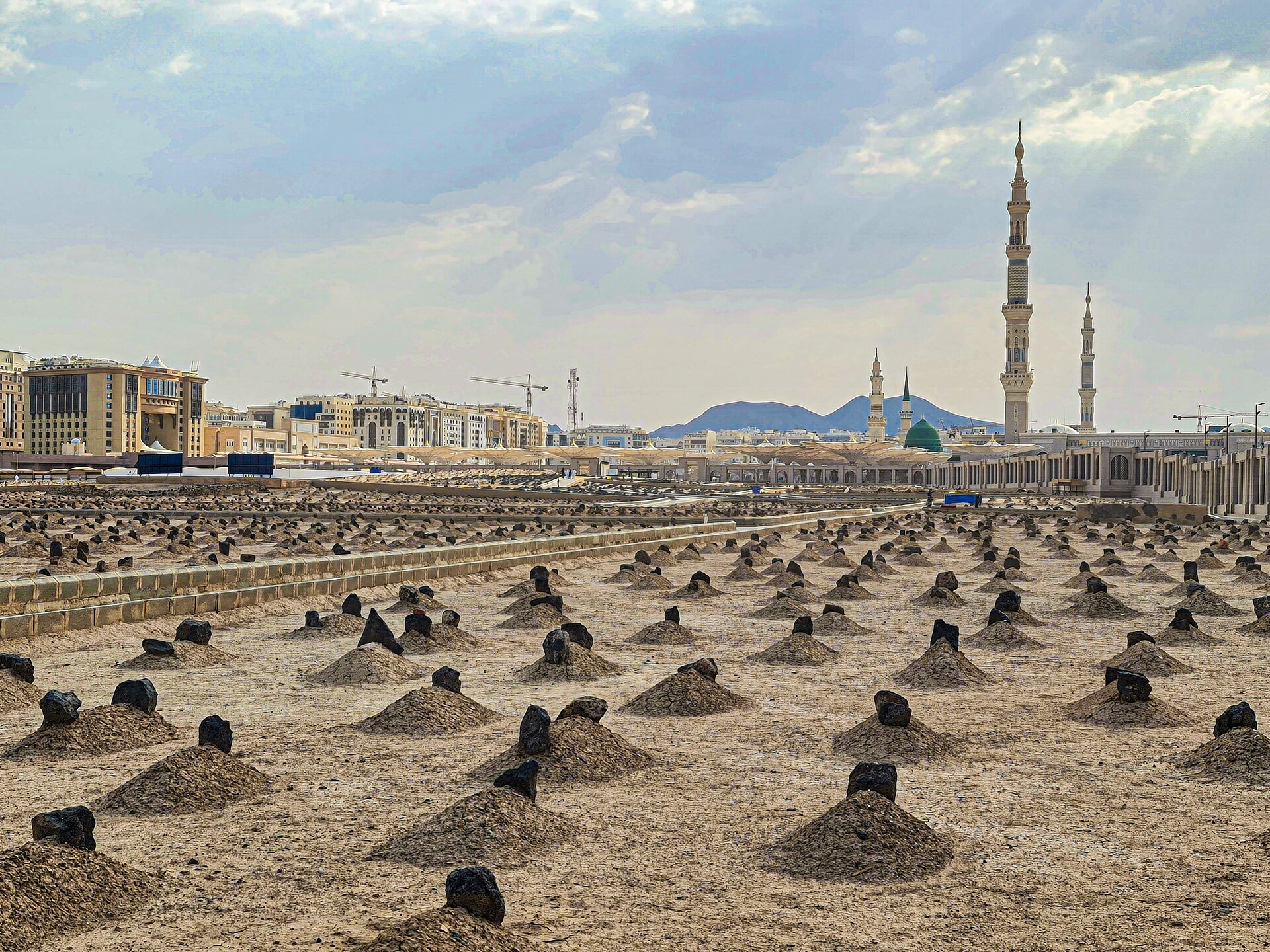
Dorar al-Saniyyah’s hadith encyclopedia presents a report instructing that Ibrahim be buried in Al-Baqi and records al-Albani’s judgment that its chain meets the conditions of the two Ṣaḥīḥ collections. We cite it as a later hadith reference for the burial place, separate from Bukhārī and Muslim’s reports of the death and tears. We avoid assigning an age because that detail is unnecessary here and appears with varying reports.
The photograph is a general contemporary view of Al-Baqi, not a picture of a verified individual grave and not a reconstruction of the event. Its purpose is to provide honest geographic context while keeping the evidence in proportion. Text and image together can teach restraint: establish what is established, label context as context, and leave the unknown without decorative invention.
Hadith texts, photograph and image rights checked on 1 September 2026
Texts and references
- Ṣaḥīḥ al-Bukhārī 1303 — the death of Ibrāhīm and the Prophet’s ﷺ tearsSunnah.com ↗
- Ṣaḥīḥ Muslim 2315 — Anas’s corroborating reportSunnah.com ↗
- Ṣaḥīḥ al-Bukhārī 1043 — the eclipse was not caused by a person’s deathSunnah.com ↗
- شرح خبر وفاة إبراهيم والدفن بالبقيعالموسوعة الحديثية — الدرر السنية ↗
- Al-Baqi Cemetery photograph and CC BY 4.0 licenceWikimedia Commons / Saleh Al Hussain (Cergun62) ↗